
by Jody McBrien, AWG Paris
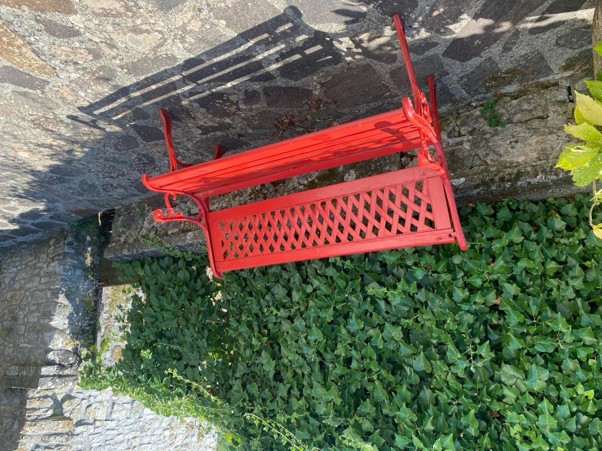 While visiting a good friend in Tuscany, we learned the meaning behind red benches.
During the brutal European heatwaves of 2026, my husband and I traveled from Paris to Tuscany to spend several days with a good friend from Sarasota, Florida. Nina generously drove us from small village to village, an opportunity we would never have had without her expertise. Nina has been coming to Cerretoli for 35 years and bought a small home there with her Italian husband. We met Nina years ago through our Unitarian Universalist fellowship in Sarasota and the Social Justice Committee there.
The Garfagnana, in northern Tuscany, is beautiful. We traveled through numerous hairpin turns going up the Apennines, encountering many villages and summer festivals. We would never have seen these lovely places without our friend.
As we walked through one small village, we came upon a red bench. Nina explained the background of the red bench project in Tuscany. “Some benches throughout Tuscany have been painted red. They serve to remind people about domestic violence towards women.” Nina told us that the local effort in Garfagnana grew out of a visit from Dr. April Gasco of Second Chance–Last Opportunity, a Sarasota nonprofit.
When I returned home to Paris, I wanted to learn more about the red benches. Was this solely a project in Tuscany? Were other areas involved?
 It turns out the red bench started in Italy. The first was installed in 2016 in Lomello, a small town in Lombardy, by the women’s network Stati Generali delle Donne. It drew on an earlier symbol, the red shoes that Mexican artist Elina Chauvet lined up in Ciudad Juárez in 2009 to represent women killed by violence. From Lomello, the benches spread to town squares, universities and public buildings across Italy. Many carry a plaque with the number women can call for help. Since 2024, Italy’s Foreign Ministry has installed them at its embassies abroad, from Berlin to Washington, and the idea has been taken up in other countries, including the UK and Australia. While writing, I was amazed to learn that a red bench has been installed in Ukraine, reported by the UNFPA. The intention of the red benches is to remind the public of the crime of domestic violence, but also to encourage conversation about gender respect.
In 2023, Italian doctors writing for VIPROM, an EU-funded project on domestic violence, drew attention to how many Italian women lack financial independence. More recent figures bear them out. According to the World Bank, about one in five Italian women has no bank account at all, compared with roughly one in a hundred in France or Germany. A survey by the Global Thinking Foundation found that only 58% of Italian women have an account in their own name, and nearly a third depend financially on a partner or family member. Without money of their own, leaving an abusive partner becomes far harder.
The VIPROM authors also pointed out that Italy, unlike most European countries, has no compulsory sex or relationship education. They argued that this leaves young people vulnerable to patriarchal models of relationships. Many schools have offered such classes on their own initiative, but provision depended on the school rather than the state. A 2026 law has since narrowed it further. Extracurricular sex-education courses are now banned in nursery and primary schools, and in secondary schools they require specific parental consent.
According to the UN, domestic violence takes many forms:
Domestic abuse ... can be defined as a pattern of behavior in any relationship that is used to gain or maintain power and control over an intimate partner. Abuse is physical, sexual, emotional, economic or psychological actions or threats of actions that influence another person. This includes any behaviors that frighten, intimidate, terrorize, manipulate, hurt, humiliate, blame, injure, or wound someone. Domestic abuse can happen to anyone of any race, age, sexual orientation, religion, or gender. It can occur within a range of relationships including couples who are married, living together or dating. Domestic violence affects people of all socioeconomic backgrounds and education levels.
– United Nations
The majority of domestic violence victims—80 to 90%—are women. Most countries have help lines that victims can call to receive information and aid to protect them from ongoing violence. Some countries also provide help to those who recognize that they are perpetrators of domestic violence.
No one deserves to be abused by a spouse or partner. If you or anyone you know is experiencing any of the threats described by the UN definition above, please reach out to an organization in your country that provides help. Consult the NO MORE Global Directory for information about helplines and resources in countries throughout the world.
Photos courtesy of the author.
More information: