By Mary Adams (AWC The Hague, Human Rights co-chair) and Marelie Manders (Heidelberg IWC, Human Rights co-chair)
What is the 16 Days of Activism Campaign?
It’s a 16-day international campaign aimed at challenging violence against women and girls. During the 16 Days of Activism, people around the world unite to raise awareness about eliminating gender-based violence, challenge discriminatory attitudes and call for improved laws and services to end violence against women for good. If you’d like to know more about the 16 days campaign, read here for more information.
The 16 Days of Activism begins on November 25, which is also the International Day for the Elimination of Violence against Women. The campaign ends on December 10, International Human Rights Day.
What can you do?
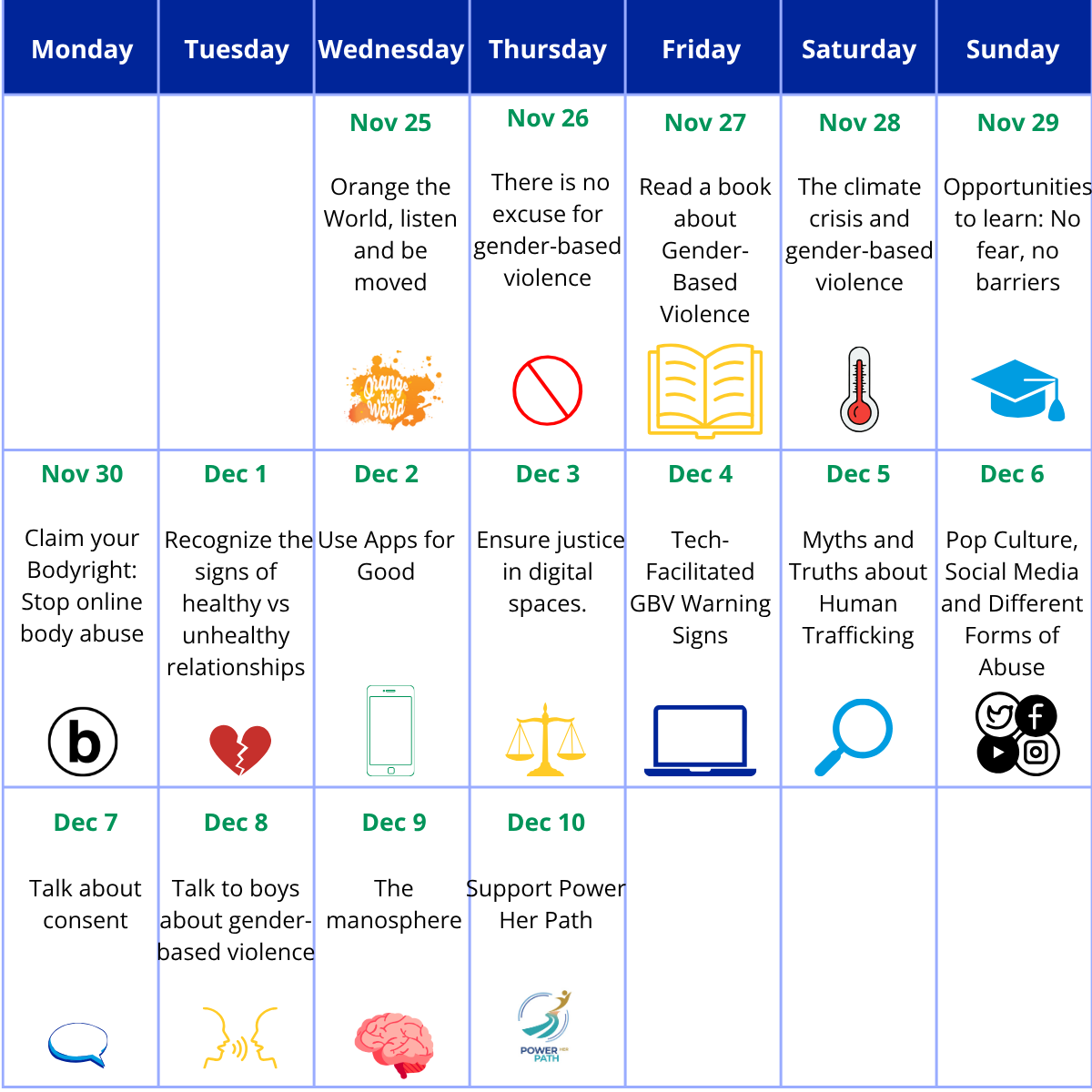
Here is a calendar of simple yet effective ways that you can show your support for the 16 Days of Activism. Scroll down to read more about each date.
2026 Calendar: November 25 to December 10, 2026
(See below for details on each individual day.)
November 25 – Orange the World and Listen and Be Moved
From November 25 to December 10 every year, the UNiTE to End Violence against Women Campaign calls on people everywhere to wear the color orange and take action to end violence against women and girls in communities, at home, in public spaces, in schools and workplaces, during conflict and in times of peace. The color orange was chosen by the United Nations to symbolize a brighter future, free of violence. Use the resources at the UN Women toolkit for Orange the World with social media resources here.
As we kick off the 16 Days Campaign, take a listen to the beautiful anthem for UN Women, “One Woman,” created by FAWCO member Beth Blatt (AAWE Paris). 25 singers and musicians from around the world collaborated to produce this musical sensation. Listen and be moved.
November 26 – There is no excuse for gender-based violence
Everyone deserves to feel safe, respected, and free from fear. It's time to break the silence, speak up, and stand together. No excuse. No violence. No more silence. Watch this video from UN Women to learn more.
November 27 – Read a book about gender-based violence
Why not choose a book about Gender-Based Violence for your next book club? The New York Public Library has a great selection here.
On January 18, 2027, the FAWCO Human Rights team will host the FAWCO Global Issues Book Discussion. The book, A Walk Across the Sun by Corban Addison, deals with human trafficking and sexual exploitation, and explores sisterhood, resilience, hope and the pursuit of justice and personal redemption. Register on the FAWCO homepage.
November 28 – The climate crisis and gender-based violence
At COP31, this year’s UN climate summit, the delegates argued over almost everything, but agreed on one thing: women feel the climate crisis first and worst, so they must help shape every solution.
Ending violence against women isn’t a side issue. Protecting the planet and building fairer economies can close gender gaps, cut poverty and make whole communities stronger.
The Environment Team invites you to:
-
Read about the interplay between rising global temperatures and the increase in violence against women in the article Rising Global Temperatures – Rising Gender-Based Violence by Maria Psarianou, Co-chair of the Environment Team, AWO Greece.
-
Find out more about how the climate crisis affects gender equality by examining this UN Women article and these fact sheets.
November 29 – Opportunities to learn: No fear, no barriers
Each year, about 246 million children experience gender-based violence in and around school, and most never report it. When a girl finally speaks up, the first person she tells can change what happens next. The UNESCO and UN Women Global Guidance shows how schools and communities can be ready to respond.
Watch UN Women’s Policy Spotlight on School-Related Gender-Based Violence. Explore UNESCO and UN Women’s Global Guidance on Addressing School-Related Gender-Based Violence to learn how schools and communities can respond.
November 30 – Claim Your Bodyright: Stop Online Body Abuse
 Violence against women and girls is a violation of human rights and bodily autonomy and a global public health issue. Humiliating and degrading bodies in cyberspace is an act of violence that must end. Stand for a virtual and real world where women and girls can live freely.
Bodyright is the first “copyright” mark to assert and demand protection from digital violence. The core of this online and social media campaign from UNFPA, the United Nations sexual and reproductive health agency, is the bodyright symbol. To own your body online, join others in claiming their #bodyright. Click here.
December 1 – Recognize the signs of unhealthy vs. healthy relationships
One Love Foundation promotes recognizing the signs of unhealthy versus healthy relationships and shifting to healthy behaviors. Help people around you understand that it is important to not ignore these signs, as they can escalate to abuse. FAWCO sponsored a One Love workshop led by youth at the United Nations CSW68 in March 2024.
Learn to spot the signs of abuse and how to start a conversation on page 46 of the Safe and Equal Toolkit.
December 2 – Use Apps for Good
Speaking up against gender-based violence and human trafficking can start with a simple action. Technology can be a powerful tool in protecting vulnerable people and raising awareness. Don't stay silent when you see something wrong. Use technology responsibly, share information, and be part of the solution. Click here to explore and download apps that can provide helpful data to law enforcement.
A SAFE REPORTING REMINDER: Your safety comes first. Never confront suspected perpetrators or put yourself at risk. Report concerns through trusted, official channels, and share information responsibly. If someone is in immediate danger, contact emergency services.
December 3 – Ensure justice in digital spaces
Digital abuse is one of the fastest growing forms of gender based violence. Every woman and girl should be aware about this and what they can do to ensure their digital safety. UN Women has this 101 Explainer that includes actions that everyone can take against digital abuse.
Read one survivor’s story here.
December 4 – Technology-Facilitated Gender-Based Violence (TFGBV) Warning Signs
Technology-facilitated gender-based violence (TFGBV) is the manipulation of technology to commit any harmful threat or act directed at an individual or group based on actual or perceived sex, gender, gender identity, sex characteristics, or sexual orientation. A 2022 Pew Research survey showed that 95% of teenagers are using social media, and 46% of teenagers say they are on the internet almost constantly. As technology advances in the areas of artificial intelligence and fake images (deepfakes), the risk to teens increases.
Learn how to identify TFGBV in your family. Check out the warning signs and how to access resources.
December 5 – Myths and Truths about Human Trafficking
Think Human Trafficking only happens when people are kidnapped and held against their will?
Being trafficked may actually be a gradual process. It may take weeks or months or grooming and manipulation by the trafficker before the victim is exploited. While victims may appear to have free will, they are often controlled by their trafficker through fear and other types of mental manipulation. Being trafficked may be a gradual process. They might not even identify themselves as a victim.
To learn more about the myths and truths about Human Trafficking, view the Human Rights Team’s Human Trafficking Mythbuster here.
December 6 – Pop Culture, Social Media and Different Forms of Abuse
The different forms of abuse and gender based violence that women can experience are all around us everyday. These news articles illustrate how this is present in our daily lives:
- Britney Spears case highlights issue of reproductive coercion, which causes suffering for many Australian women
- We’ve come to expect being treated badly on dating apps
- #MeToo on TikTok: Teens use viral trend to speak out about their sexual harassment experiences
- Growing up online: How violence follows girls across platforms
December 7 – Talk about consent
Asking for and obtaining consent shows respect for yourself and your partner. It eliminates the entitlement that one partner might feel over the other. Neither your body nor your sexuality belongs to someone else.
The Eau Claire Health Alliance Consent is toolkit, has some fantastic resources! These include Consent for Kids, a video explaining consent in language for kids, videos about Consent for Young Adults/Students and lots more.
December 8 – Talk to boys about gender-based violence
Teenage boys don’t grow up in a vacuum. From the moment they start school, they’re taught, directly or indirectly, that “real men” don’t cry, don’t talk about feelings, and don’t like being told they’re wrong. So when we bring up misogyny, violence against women, or "toxic" masculinity many boys immediately feel accused.
This article offers some guidance on how we could talk to boys about gender based violence.
Sometimes the question whether men and boys are not also victims of violence will come up. This important question deserves a thoughtful answer.
December 9 – The Manosphere
Gender stereotypes are harmful to everyone! What is the manosphere and why should we care? The UN has an explainer.
UN women offers a helpful guide on how to talk to your teenagers about the manosphere.
December 10 – Power Her Path
FAWCO’s Target Project 6: Power Her Path is underway, helping survivors of forced marriage, online scams and forced labor to access the tools, resources and opportunities they need to reclaim their lives. Your clubs' donations of $66,000 has enabled three female survivors of gender-based violence in Vietnam to receive vital support, including legal assistance, counseling and career guidance and enabled the implementation of the Compassion Station.
We have achieved 47% of our target goal of $140,000. Survivors need more than rescue - they need pathways to independence, dignity, and sustainable livelihoods. Click here to donate.