by Mary Adams, AWC The Hague
 From 2015 to 2017, I served as the Global Fundraising Manager for The FAWCO Foundation. In that role, I helped develop a global symposium in The Hague called Stand UP Against Human Trafficking. Before that project, I will admit I had never even heard the term. That symposium was my “Human Trafficking 101,” and my first reaction was a numbing shock at the sheer evil humans are capable of. But as an advocate, I’ve learned that we cannot stay numb. We must understand the mechanics of this hidden global economy.
To begin, we must refine our language. Today, “slavery” is largely a historic reference. We now use Modern Slavery as an umbrella term that encompasses human trafficking, forced labor, and even human smuggling that shifts into exploitation. It is a market that treats human beings as commodities, and business is booming.
Takeaway 1: The "infinite" commodity
Human trafficking is not just a collection of crimes; it is a sophisticated, illegal global economy. The International Labour Organization and the UN Office on Drugs and Crime estimate that trafficking generates $236 billion in annual illegal profits. To grasp that scale, the projected profit over a ten-year period is $2.35 trillion—roughly equivalent to the annual GDP of Canada.
There is a chilling economic factor that makes this trade more lucrative than any other. Human beings are renewable resources.
This capacity for repeated use is why commercial sexual exploitation remains the leading profit-maker in the industry. While a bag of cocaine is sold and consumed once, a human being can be exploited multiple times a day, every day, generating an “infinite” return on a trafficker's initial “investment.”
Takeaway 2: The $62 billion understatement (the digital age shift)
The digital age has ushered in the era of “forced criminality.” Traffickers have pivoted toward cyberscams that are easily scalable and require no movement of physical goods across borders. While current estimates suggest illegal profits in Southeast Asia are $62 billion, that figure is likely a gross understatement—as Interpol reports, over 300,000 people have been trafficked into scam centers in that region alone. In the eyes of a global analyst, $62 billion sounds like “peanuts” compared to the likely reality of this skyrocketing industry.
Takeaway 3: The myth of "somewhere else"
We often treat trafficking as a tragedy happening “somewhere else,” usually in developing or unstable nations. The Global Slavery Index proves no country is untouched. North Korea has the highest prevalence, with 1 in 10 people trapped in state-sponsored modern slavery. However, even “top-performing” nations harbor hidden exploitation. The United Kingdom holds a score of 68/100, yet a 32% gap remains in its response. As advocates, we must be critical: this gap is directly widened by recent and proposed changes to UK immigration policies, which increase victim vulnerability and weaken survivor support.
Takeaway 4: The uncomfortable reality of perpetrators
To disrupt human trafficking, we must move past the “shady criminal” stereotype and recognize trafficking as a business. Perpetrators use typologies ranging from “one-to-one” to “one-to-many” models, mimicking legitimate corporate structures. These networks rely on a chain of facilitators—investors, recruiters and money-launderers—who may not even realize they are aiding a crime.
The most disturbing aspect is the gender of the perpetrators. Women operate at every level of these networks, including high-level management and leadership. This reality complicates identification efforts; law enforcement often fails to intervene because they operate under the flawed assumption that women in these environments are exclusively victims. By defying traditional criminal profiling, these women help trafficking networks evade detection.
Takeaway 5: The unconscious consumer and your "slavery footprint"
The financial incentive for trafficking exists because there is a demand. While the commercial sex market is driven almost 100% by male buyers, the labor market is driven by “unconscious consumers”—everyday individuals, many of them women, who drive demand through their purchasing habits. Find out how you can make your shopping slave-free by reading our Conscious Consumer Toolkit.
From awareness to advocacy
Technology is a double-edged sword, but it is becoming our greatest tool for disruption. Organizations like Tech Against Trafficking are leading the charge through their “accelerator program” for funding anti-trafficking tools and maintaining a comprehensive “anti-trafficking tools map.” As citizens, we can join this fight by downloading apps like STOP, and TraffickCam to report suspicious activity.
The shift from being a bystander to an advocate begins with a simple commitment: if you see something, say something. Investigate your buying habits, support survivor-led initiatives and demand better policy protections. Awareness is the first step, but only action can close the $236 billion market for human lives.
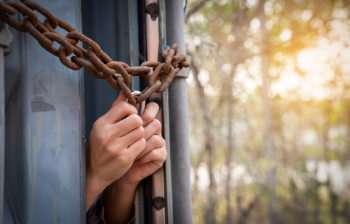
Photo courtesy of canva.com