by Monica Jubayli, AWC Lebanon
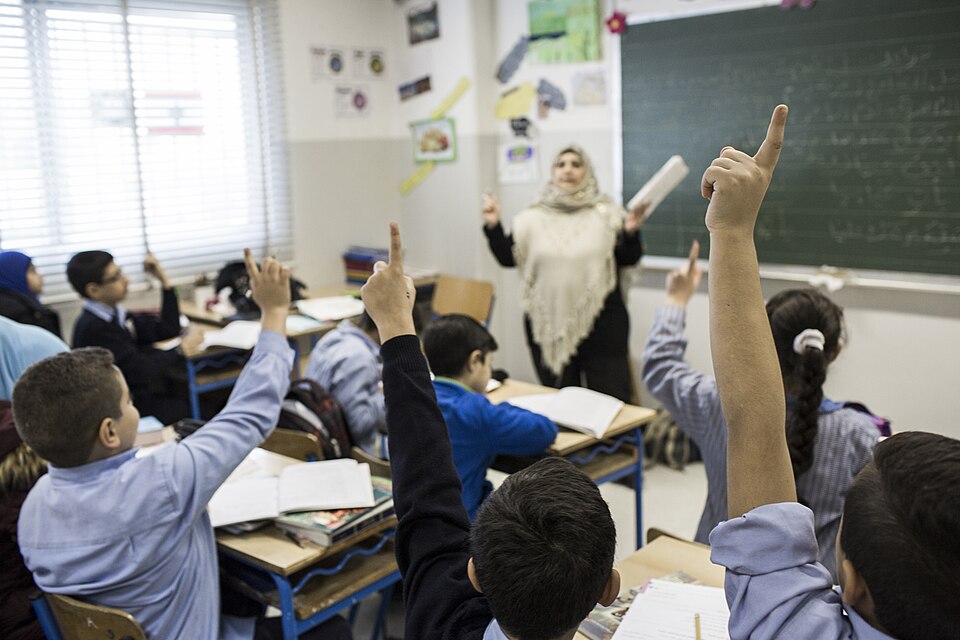
Syrian students are back in class in Beirut, Lebanon, 2016. Photo: DFID – UK Department for International Development, CC BY 2.0, via Wikimedia Commons
Lebanon’s public schools had already been struggling, as the nation is host to more refugees per capita than any other country in the world (131 per 1,000).1 Many schools were operating a morning shift for the local children and an afternoon shift for the Syrian refugees. Then came the 2019 financial collapse, Covid-19 closures, the Beirut Port explosion and years of instability, and in March 2026, war—which brought even greater challenges to the country’s education system. The war only exacerbated an already extended disruption of learning that has been ongoing. How did this come about?
Since the fall of 2019, when Lebanon’s economy imploded and its currency lost more than 98% of its value, the implications have been far-reaching. In simple terms, a teacher’s average salary was about $1,000. Today that teacher earns about $200. This situation precipitated prolonged teachers’ strikes as they asked for a living wage. NO SCHOOL.
When Covid-19 hit in March 2020, schools closed and switched to distance learning. Public school students, primarily from underserved communities, were unable to get online because they had no access to computers, and even if they did, they had only a few hours of electricity per day, and therefore, no internet. NO SCHOOL.
The Beirut Port Explosion in August 2020 damaged or destroyed between 163 and 180 public and private schools, disrupting education for nearly 85,000 students. NO SCHOOL.
From 2021 to 2023, learning was interrupted again and again: by recurring teachers’ strikes, by protests over the stalled investigation into the port explosion, by attacks on banks related to corruption, and by a political deadlock that left the country in a power vacuum without a president, while tensions rose on the border with Israel. NO SCHOOL.
The spillover from the War in Gaza in October 2023 resulted in the loss of school days in the South as displaced families sought shelter in public schools. Continuous cross-border attacks lasted throughout the year, culminating in all-out war in September 2024, until the November 2024 “ceasefire.” NO SCHOOL.
During the 2024–2025 academic year, the Lebanese Ministry of Education conducted a study to assess the impact of the preceding years on education.
In mathematics, the assessment reported learning losses equivalent to approximately 3.15 years by Grade 6. More than 80% of Grade 6 learners had not mastered division, while nearly 60% experienced difficulties with fractions. In languages, substantial gaps were identified in reading fluency, reading comprehension and writing across Arabic, French and English, with more than 70% of Grade 1 learners experiencing difficulties with foundational reading skills.2
In March 2026, the “ceasefire,” which saw low-intensity fighting and instability, finally collapsed and heavy airstrikes and an Israeli incursion into southern Lebanon resulted in over one million people being displaced, many of them finding refuge in public schools. NO SCHOOL.
- 86 teachers were killed or injured, and nearly 20% of students and 12% of their teachers and staff became displaced.
- 200,000 students faced severe disruption, and of those, 100,000 were from schools that had been destroyed, severely damaged, or the students themselves were displaced, so they did not return to their schools.
- 436 schools out of 1,089 public schools suffered damage from attacks
- 37 destroyed
- 64 severely damaged
- 433 schools were used as shelters at the height of the war; by the end of August 2026, 99 schools were still operating as shelters.3
The toll has been great.
Lebanon was once a glowing star in the Middle East, wealthy in its human resources. With no oil to depend on, many Lebanese went to the Gulf countries as educators, civil servants and engineers because they were well known for being highly educated.
These days, public schools are suffering as the standard of education is falling. Globally, most countries spend between 3.6% and 4.4% of their GDP on education; in Lebanon it has fallen to 1.22%–2.4%. In actual figures, “education spending in Lebanon declined from $1.2 billion annually between 2013 and 2015 to $114 million in 2022.”4 The result is that teachers’ salaries are dismal, schools don’t have the money to pay for the simplest of office supplies, like toner for the copy machines, let alone enough to pay for diesel to run generators to power the school since there are constant power outages.
This does not take into account the psychological toll of living in a war zone, on top of the extreme stress that the economic situation has caused so many families.
International and local donors do their best to put a finger in the dike, but for how long? International aid is drying up, and local sponsors are suffering from donor fatigue. Unfortunately, as the need increases, the aid is shrinking.5
Despite these challenges, there are some bright spots when local organizations work together with partners to make a difference.
- Jennifer: Despite facing significant trauma and health risks following the Beirut Port explosion, which devastated her neighbourhood of Achrafieh, and grappling with severe financial constraints, Jennifer pursued her education with unwavering determination. Now, Jennifer stands as a university graduate, employed and self-financing, and is currently pursuing her master’s degree!6
- Alaa, like many girls in her community, often hears that a girl’s place is at home, not in a STEM lab, but she thinks differently. “School means everything to me. I want to become a doctor.” When computer science class began at her school, Alaa found something that pushed her to think and work in new ways. She laughed, telling us about her first game. “When it moved, I felt proud. I didn’t know I could do that!” Now she wants other girls to get the same chance.7
- Nayfa, a recent university graduate: “We never expected to leave our country and see our homes destroyed without being able to do anything. We never expected to witness everything fade away at that moment; our home, our school, our dreams and our future … We left in a dark night and only carrying some clothes in the hope of returning a few days later, but the days have passed, and the months have passed, and we started to realize that no salvation is coming soon. Grief began to dominate us and despair infiltrated our weary souls; no study, no work, no hope. And If these things are lost, then life becomes meaningless.”8
- Sixth grade student: “At first, I didn’t know anything about coding. It seemed hard and confusing,” she shared. This year, she’s learning Scratch, a visual programming language that’s helping her think differently. “It’s facilitating my learning experience, especially in math,” she explained. “Coding helps me break down problems and solve them step by step.”9
Hopefully, the well-known resilience of the Lebanese people will prevail. In the darkest hours, it is always important to shine the light.
References:
- “Ranked: Refugees Hosted Per Capita by Country,” Visual Capitalist, June 14, 2026.
- Lebanon Ministry of Education and Higher Education, The Impact of War on Lebanon’s Education Sector (UNHCR Operational Data Portal, October 28,2026), p. 10.
- Ministry of Education and Higher Education, The Impact of War on Lebanon’s Education Sector, p. 4.
- Education International, “Lebanon: Go Public! Fund Education, from Words to Action,” October 10, 2025.
- Yara Sarkis, “Lebanese NGOs Struggle amid the Surge in Humanitarian Needs,” L’Orient Today, March 16, 2026.
- CodeBrave, “Our Impact,” accessed November 12, 2026.
- CodeBrave, “Our Impact.”
- Society for Social Support and Education, “Success Stories,” accessed November 12, 2026.
- Cedar Gate Fund, “How Coding Is Transforming Classrooms: A Student’s Story from Ajyal School,” accessed [date].