
by Ulrike Näumann, Heidelberg IWC
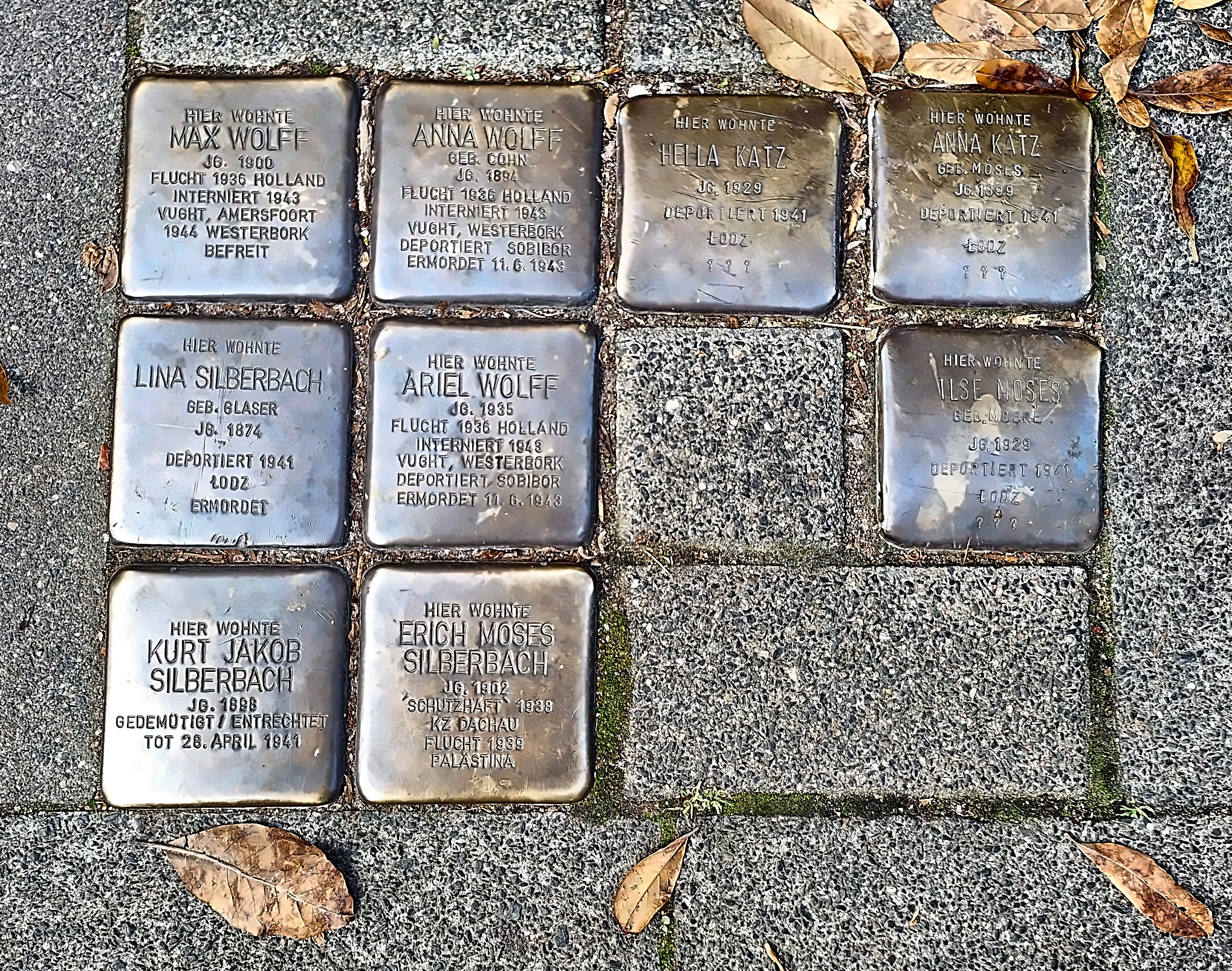 I have just returned from the 2026 FAWCO Region 5 Meeting in Cologne with a story that deserves to travel beyond our weekend.
On the Stolpersteine tour, our guide Terry Mandel spoke outside her mother’s former home, beside the Stolperstein bearing her relatives’ names. For me, this encounter became a powerful reflection on what education can set in motion.
A student asks a question
In July 2021, sixteen-year-old Anna contacted Terry through Ancestry.com while researching Ingelore Silberbach for her history course at Cologne’s Königin-Luise-Schule, unaware that she was writing to Ingelore’s daughter. A school assignment had opened a door that decades of silence had kept closed.
Learning across generations
Ingelore had been expelled from the school for being Jewish and fled with her family in 1938, eventually finding safety in the United States. Through photographs, documents and conversations, Anna and Terry began piecing together parts of the family’s past that had never been spoken of. The student was not simply receiving knowledge: she was helping someone else discover it.
From remembrance to engagement
That encounter helped inspire Terry to found The Unerasure Projekt, which also has a German association, Freundeskreis The Unerasure Projekt e.V. Through experiential learning, storytelling and dialog, her work in Cologne and beyond invites people to explore hidden family histories and consider how the past shapes their choices today. This is remembrance not as a finished lesson, but as an invitation to participate.
Why the classroom matters
For FAWCO’s Education Team, Anna’s story offers a compelling reminder: good teaching does more than transmit facts. It creates space for curiosity, careful research and questions whose answers may matter far beyond the classroom. Historical knowledge is essential; personal encounters can help students understand why it matters.
Anna’s story shows what such an encounter can look like. As part of their research into former Jewish pupils of their school, history teacher Dirk Erkelenz encouraged his students—Anna among them—to reach out to the families of those who had been persecuted under National Socialism. When we teach about the Holocaust, or about any history of persecution, we can follow his example: wherever possible, we should guide young people towards personal contact with the descendants of victims. Such encounters build bridges in both directions.
Many descendants sense, often unconsciously, that something happened in their family that no one ever spoke about—the violence done to their ancestors can live on in silence, pain and fear. Terry would never have learned her own family’s story if Anna had not contacted her. With one email, Anna gave Terry back a part of her history—and helped her turn an inherited silence into a mission.
We cannot ask young people to change the past. We can equip them to recognise exclusion, question silence and act responsibly in the present. One teacher created the opportunity. One student sent an email. What might happen if more classrooms made room for that kind of learning? Each of us can help open such doors in our own communities—by supporting local history and Stolpersteine projects, bringing generations together to share their stories, or encouraging young people to explore history in a personal way.