by Margie O’Rourke, AWC Dublin
 At fifty years of age, I thought I had myself fairly well figured out. I was working full time, raising a family, and living what most people would call a settled life in Dublin. Then a neighbor’s son died by suicide, and the shock of it sent something in me reeling. I kept circling the same questions: Why did this happen? Couldn’t he have spoken to someone? Had he truly felt that alone? I felt helpless—not for lack of caring, but for lack of understanding.
In that confusion, I made a decision that surprised even me: I enrolled in a psychology degree course with the Open University. I think some people assumed I was taking up a “little course” to keep myself busy. They didn’t know I was about to dive into a six-year academic marathon while holding down a job and managing a home. But once I began, something opened in me. Studying at this stage of my life was surprisingly easy. I enjoyed the structure, the organization, the sense of my mind stretching, and walking through doors I didn’t even know were there.
Once a month I attended tutorials, and in addition to the tutorials, a group of us students gathered for what we jokingly called our “jam session”—not a guitar in sight, just laptops, textbooks and enough tea to hydrate a small nation. Those sessions kept me going. We were all juggling something, so there was no room for pretence. We became a lifeline to one another.
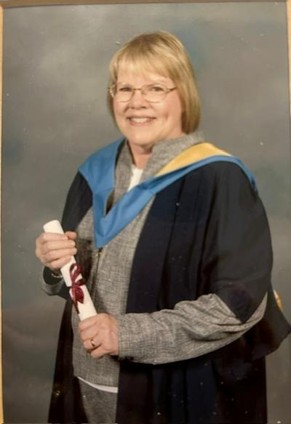
For six years, I studied fifteen hours a week. Exams were stressful, of course—they always are—but they were doable. And because the process was so rewarding, my energy levels never wavered. I didn’t dread the work; I welcomed it. Every assignment felt like a small victory. When I finally graduated with honors from the Open University, I felt I’d achieved something I never could have imagined in my younger years.
The real change was in me. I became more confident, more curious, more willing to examine things from every angle before drawing a conclusion. I made friends across the world—people I’d meet in online forums, people who challenged my thinking, broadened my worldview and left their fingerprints on my education. The world got bigger.
Yet, for all that I learned, I still cannot fully understand why that young lad took his own life. And I’ve accepted that I never will. No degree—British, Irish or otherwise—can open the sealed door of another person’s crisis moment. The human mind guards its pain fiercely. What I did learn, though, was to listen. Properly listen. To sit with someone’s distress without rushing to fix it or tidy it away. To be present, steady, and unafraid of silence.
Ironically, because my degree was from a British institution, I couldn’t practice in Ireland unless I undertook further full-time study in Galway. At that stage of my life—with a job, a family, and a home in Dublin—there was no universe in which I could pack up and move. So, my qualification remained academic rather than professional.
But here’s what surprised me: I wasn’t disappointed. Somewhere along the way, I realised that the “process” of earning the degree had become as important—perhaps more important—than any career outcome. It reshaped me. It gave me tools, language and a confidence I hadn’t known I lacked. It helped me understand people, and myself, with more compassion.
I’m retired now, the textbooks long since back on the shelf. Returning to adult education remains one of the best decisions I ever made. It didn’t just give me a degree; it reshaped my life, my thinking and my heart. It taught me that it’s never too late to learn, never too late to grow, and never too late to become the person someone else might finally feel safe speaking to.
It taught me that growth doesn’t have an age limit, and that sometimes the journey—not the destination—is where the transformation happens. It didn’t solve the mystery of that young man’s final moments, but it made me the kind of person who can hold space for others when their own moments feel too heavy to bear. And perhaps that is its own kind of answer.
Looking back, I realize the degree itself was only part of the story. The deeper lesson was discovering that growth and curiosity do not belong only to the young or even confined to a classroom. Have you returned to study, taken on a new challenge, learned a new skill or language or started your own business later in life? These are the areas of lifelong learning we’d like to have a conversation about. What drew you to it, and what did you discover along the way? If you’d like to share, please reach out to .