by Mary Adams, AWC The Hague and Human Rights Team Co-Chair
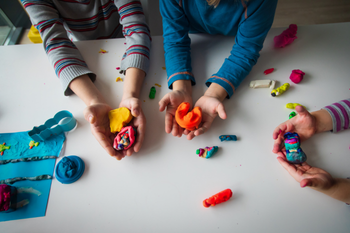 The International Day of Play is celebrated each year on June 11 to highlight the importance of play in children’s development and well-being. This year’s theme is “Protect play, protect childhood.”
The Brookings Institution has confirmed that cities can support guided play learning. In Philadelphia and Santa Ana, public spaces are being redesigned to support children’s development and community interconnectivity. Instead of limiting learning to classrooms, Playful Learning Landscapes initiatives embed learning into daily life.
UNICEF recently reported that nearly two-thirds of 10-year-olds cannot read and understand simple text. Consider this: a child has about 5,475 waking hours each year. Depending on the country, only 10–20% of those hours are spent in school.
In 2025, the Brookings Institution proposed that the “other 80%” of children’s waking hours represents a massive, untapped frontier for learning. This is where Active Playful Learning comes in—a concept grounded in how the brain naturally develops. Research shows that children learn best when experiences are active, engaging, meaningful, social, joyful, and iterative. Both free play (child-led and open-ended) and guided play (structured toward learning goals) are essential. But guided play sits in the “sweet spot,” where children’s natural curiosity meets intentional, research-based learning outcomes.
Turning Grocery Shopping into STEM Learning
Northgate Market is a mainstay of Southern California’s Latino community, but what can Latino children and their families learn in a grocery store? In Santa Ana, the Supermarket Speak initiative turns grocery shopping into a hands-on learning experience.
Assistant Professor Andres S. Bustamante, a developmental psychologist from the University of California Irvine, worked with the Santa Ana Early Learning Initiative to host 20 design sessions with Latino families to share their grocery shopping experiences. A wealth of anecdotes emerged, such as an uncle who accidentally bought twice as much ham as he needed because he didn’t understand conversion from kilos to pounds and a grandmother’s secret about how to tell if an avocado is ripe.
Instead of translating materials into Spanish, Bustamante and his colleagues used these stories to create signs and activities incorporating values like familismo (family interconnectedness). Simple, colorful prompts placed throughout the store encourage children and their caregivers to explore math and science concepts together. Questions like “How many eggs are in a carton?” or “Where does milk come from?” transform routine errands into meaningful conversations. Signs using grams instead of pounds foster conversations about math and science. As children move through the aisles, they estimate, compare, count and classify grocery items.
By including guided play-reading in a space families already visit, learning becomes natural, practical, and engaging.
Turning Public Spaces into Reading Adventures
The signage at Northgate Market is just one of several installations designed to foster educational moments in public spaces throughout Santa Ana, funded by Bustamante’s National Science Foundation grant.
Bustamante’s community conversations also resulted in understanding that when growing up, many families used an abacus to learn math. The team designed a giant abacus at a bus stop as a hands-on learning environment. The city of Santa Ana incorporated the design into its planned upgrades to the Main Street corridor, and is funding the construction of a play-themed bus stop. Neighborhood bus stops will also be upgraded to feature the bingo-type card game Lotería and murals with an “I Spy” style list of items for children to find in the artwork.
As part of Philadelphia’s Reading Promise, a citywide literacy initiative, Playful Learning Landscapes created playful learning public transit landscapes. Through storytelling prompts and shared reading cues, families are encouraged to read together, ask questions and connect stories to their own experiences. Children develop critical thinking by reflecting on characters and imagining new possibilities.
The result is more than reading—it’s conversation, creativity and connection.
The Advocacy Edge
What makes these initiatives effective is their connection to everyday life. They strengthen the scaffolding children need for language and math—not through formal lessons, but through meaningful family and community interactions. This attention to cultural relevance matters. When learning feels familiar, fun and meaningful, engagement follows.
For policymakers, the lesson is clear: guided play learning interventions succeed when they align with the realities, values and experiences of the communities they serve.
FAWCO Action
Interested members can get involved in Playful Learning Landscapes by contacting the PLL City Network.
How children learn is something that we are all interested in, some of us from a scientific perspective, others from a policy perspective, and many of us from the perspective of parents. Learn more about how parents can support their children with guided play here.
Sources:
- Let me learn – Tackling the learning crisis; UNICEF
- Youth Spend 80% Outside the Classroom; STEM Next
- A Marketplace of Learning; Advancing Magazine, UCI School of Education
- Playful Learning Landscapes
- From evidence to action: How cities are investing in playful learning landscapes; Brookings Institution
Photo from Canva.com