
by Jody McBrien, Target Program Chair, AWG Paris
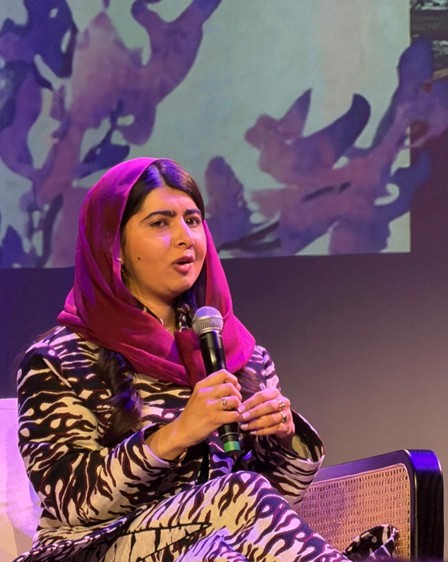 On December 2, 2025, I had the honor of hearing Malala Yousafzai be interviewed in Paris by Natalie Portman. I attended with several members of AWG and AAWE Paris and friends from my UU congregation. Now 28 years old, Malala has recently published her eighth book, Finding My Way, which is a largely autobiographical account of her years after moving to the UK and finding herself struggling at university.
Most of us know Malala as a heroic female who began her activism as a very young child, which resulted in her near-death by Taliban gunmen who shot her in the head in 2012. She was stabilized and transferred to a hospital in Birmingham, UK; she has had eight operations since her attack.
Malala’s father, Ziauddin Yousafzia, was an educator and activist for girls’ rights who encouraged his daughter to fight for girls’ education. She received Pakistan’s first National Youth Peace Prize in 2011 when she was 13, and was nominated for the International Children’s Peace Prize by Desmond Tutu. In 2014, at the age of 17, she became the youngest recipient of the Nobel Peace Prize.
Malala is known as an iconic women’s activist, and has been since childhood. So this interview touched me by showing the very human side of this remarkable young woman. She described the difficulty she had in secondary school in the UK, trying to make friends while learning the language and working through PTSD. She felt friendless, and she missed her friends in Pakistan.
Once she entered Oxford, Malala described her life as anything but what most people might imagine. She said that she joined almost every club, every sport, and attended many all-night parties, and engaged in pranks, as her primary desire was to gain friends. Ironically, this champion of education was in danger of failing.
True friendships helped Malala rebalance her life, as she found security and non-judgment from those whom she came to trust, laugh with, and “be [her] old self.”
Mental health is a topic that Malala cares deeply about, as she suffered from PTSD and anxiety, but initially thought that medications would take care of it. There was stigma around therapy in Pakistan, and as she was viewed as a major figure in women’s activism, she feared that therapy would indicate that she was weak. At university, she learned the value of therapy, and she also became aware that so many people from her part of the world don’t have the same opportunity. Therapy also helped her to realize the importance of other basic fundamentals: physical health and activity, sufficient sleep and hydration, for example.
Malala married Asser Malik in November 2021. His work is involved with sports, and both Malala and Malik are now working to help Afghan girls be able to involve themselves in sports through their many projects. For a long time. Malala felt that she was not someone who was intended for love or marriage. She witnessed the lack of opportunity that Pakistani women had for their ambitions, including her mother, and she felt that she could not do her work and be married. In the interview, she mentioned that when fathers and brothers stand up for their daughters/sisters, they are lauded, but this does not happen when mothers do the same. She also described an example of a photo of her at Oxford in jeans and a hijab that created angry controversy in Pakistan. But, she said, her brothers changed their clothing, and nothing was said about them. This double standard is problematic. In discussing her husband, she stated that they had the same regard for equality.
Malala spoke about the current situation in Afghanistan for girls and women. She stated that one girl she spoke to recently said, “Even reading a book in my room is an act of resistance.” Understandably, she is frustrated (as are so many of us) that many countries have normalized relations with Afghanistan as it continues to create a gender apartheid situation in the country.
Her foundation continues to make progress in the area of girls’ and women’s rights. One example she gave was Tanzania, where teenage mothers had been barred from attending school, with no penalties for the men who impregnate them. She stated that this has been reversed.
I came away with an image of a delightful, highly committed woman with a great sense of humor and an understanding of committing to a “normal” life while also being a symbol for worldwide women’s rights.
I just ordered Finding My Way: A Memoir, and I hope you will read it too! When it comes to human rights in the form of women’s rights, Malala offers us a remarkable role model.
Photo courtesy of Amy McCarthy