
by Maria Psarianou, AWO Greece, Environment Team Co-Chair
We have forgotten how to be good guests, how to walk lightly on the earth as its other creatures do.
– Barbara Ward (1914–1981), Only One Earth, 1972.
How often have you heard the phrase or even used it yourself “you’re such an animal”—or in your attempt to become more expressive, often after a heated debate, described someone as a “pig,” “rat,” “snake” or “worm,” subliminally giving unsavory human attributes to innocent animals? In English, as in many other (but notably not all) languages, you can insult a person by calling them an animal name, putting them in a position inferior to humans. Does this simple use of words mirror our views of human supremacy and dominance, thus justifying our abuse, exploitation or dismissal of animals? What happens when we destroy the natural habitats and ecosystems we share? Who will give the voiceless a fair shake when, unlike us, they can’t rally in the streets, protest, vote and defend their non-human rights? Many activists worldwide are spearheading the campaign for a gentler, just handling of animals and preservation of animal species—and many of them are artists.
In the earliest known art form, primitive cave art, animals as the major subject portrayed are revered and respected, but as modernity advanced, our relationship with animals receded. In David Quammen’s book Monster of God, the men/women who painted the images on the walls of the Chauvet Cave in southern France “… recognized more than danger, strength, and power. They also saw grace, grandeur, lordly confidence, quietude, mercilessness, keen attention, and some sort of all-driving primacy in those ferocious beasts; …………. Call it shamanism, call it totemism, call it idolatry. Call it, simply, art.”
 The largest exhibition organized at the National Museum of Contemporary Art Αthens (EMST) is also the first major exhibition internationally on non-human rights, running from May 16, 2025 to April 15, 2026. “Why Look at Animals? A Case for the Rights of the Non-Human Lives” is an alarming, riveting, enlightening, profound encounter, with visual and sensory messages only art can deliver. Katerina Gregos, curator of the exhibition, EMST’s creative director and winner of the 2025 Nancy Regan Arts Prize, describes the exhibition: “At its core, ‘Why Look at Animals? A Case for the Rights of Non-Human Lives’ is an attempt to shift our gaze from a purely anthropocentric worldview to one that recognises the rights, agency, and suffering of non-human beings.”
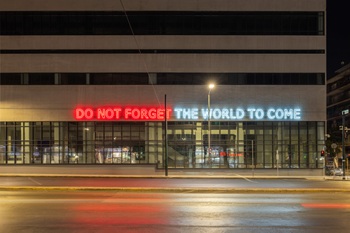
Starting from Tiziama Pers’s neon sign “Do Not Forget/The World to Come” on the face of the EMST building and the Ιgor Grubić “Do Animals… ?” posters scattered in the area around the museum, the exhibition extends throughout four floors of the museum and features over 200 works by more than 60 artists.
The exhibition consists of video, photographs, sculpture, documentary film, tapestry, drawings, posters and mixed media installations. As we start on the lower level and move upwards, the artworks express the dire effects on animals of colonialism, expansion, war, sport and amusement hunting, industrialization, animal testing, space exploration, habitat destruction and factory farming. To wrap up the total experience, the top floor is meant to leave us with a somewhat optimistic outlook for the future; the animals are part of a satirical, whimsical, dreamlike world.
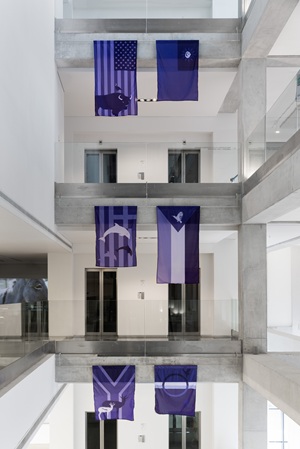 Using the escalators to move from floor to floor, we see the hanging installation of 20 country flags created by Finnish artists Gustafsson & Haapoja: Embrace Your Empathy. Each flag depicts an endangered animal associated with that particular country (for Greece it is a dolphin).
After spending several hours during two visits to the museum, with great difficulty I was able to single out three artworks to spotlight, mostly on the basis of their simplicity and personal level of impact.
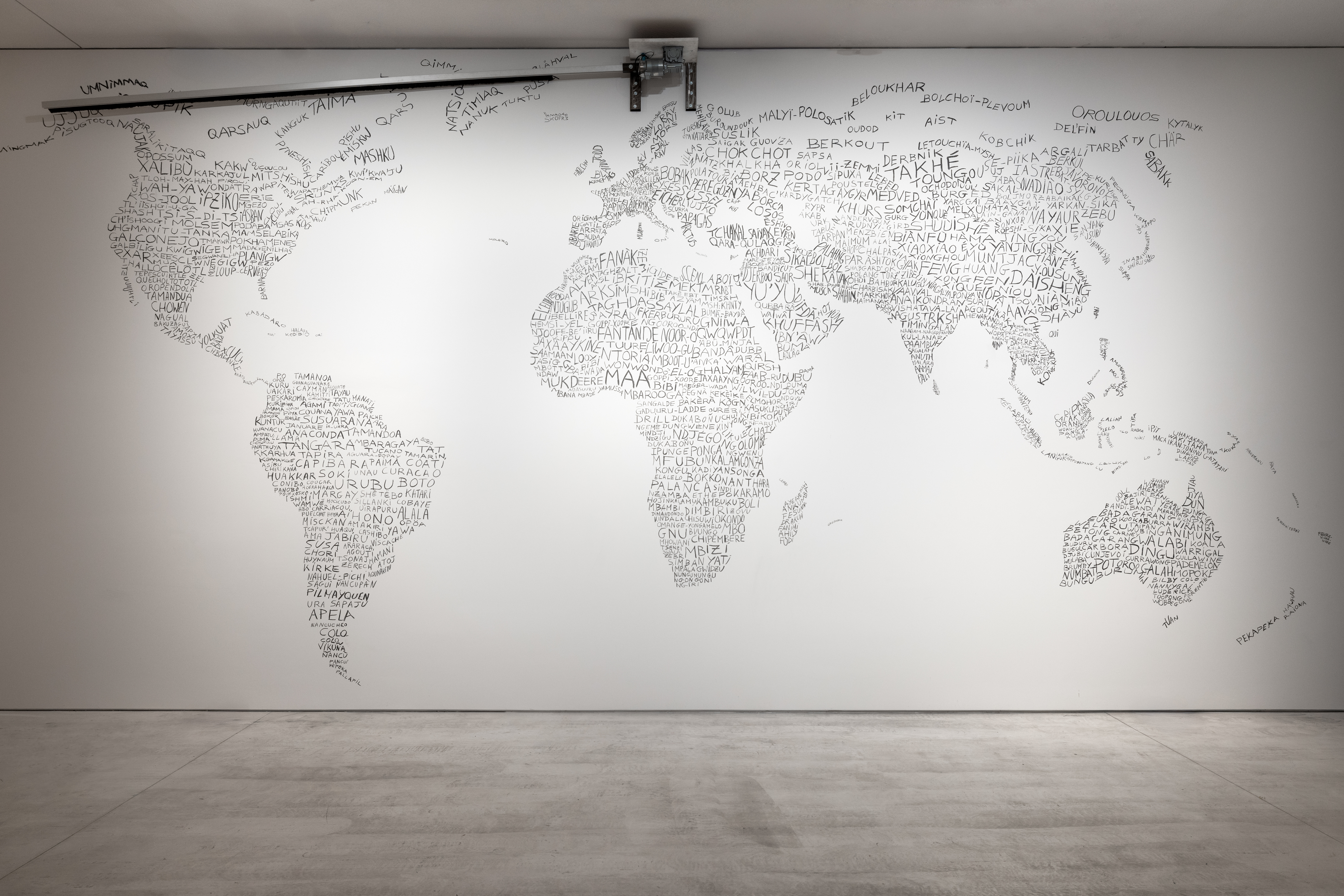
The charcoal drawing of the French art group Art Orienté Objet titled L’Alalie (a French word meaning a condition of speechlessness brought about by severe shock), is a large-scale map commanding an entire white wall made up of the names of endangered animals carefully written in their corresponding habitat countries and languages (some in languages that are also endangered or extinct languages). A mechanical brush moves along, slowly erasing the names in a continuous loop over the span of 48 hours, symbolizing the span of time it takes for a species to become extinct. It was interesting to compare the photo I took of the map on my first visit to the museum on June 1 of last year with the one from my second visit on January 23 and to come to the grim realization of what that brief time period meant for the lives of so many animals.
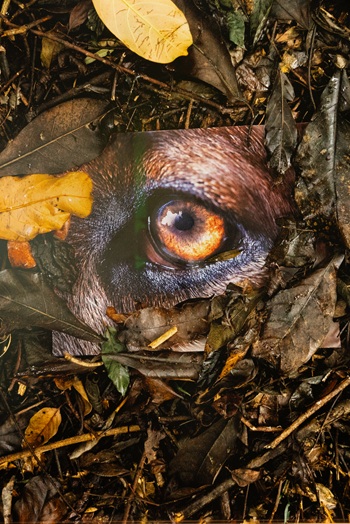
The La Pensée Ferale photographs by the Spanish artist residing in Brazil, Daniel Steegmann Mangrané, depict the eyes of domesticated dogs turned feral eerily gazing out of tree trunks and in the fallen leaves of the Tijuca National Park. The park, located in the mountains of Rio de Janeiro, is one of the largest urban parks in the world. Are they trying to dissolve into the landscape in a desperate attempt to escape from us, or are they conveying the message that they have their watchful eye on us and are warning us not to disturb their space?
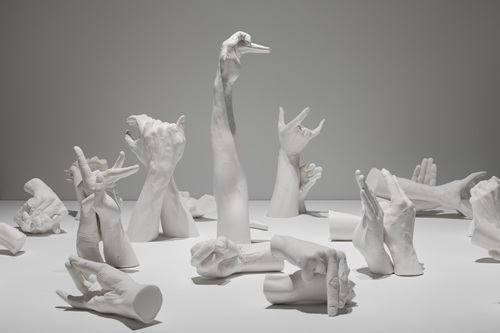
My favorite piece by far is Extinct Animals, the set of 19 plaster casts of the British artist Marcus Coates’s hands, each taking the shape of an extinct animal performing the animal shadow on the wall game. The Labrador duck, Eastern Elk, Pied raven, Golden toad and Javan tiger are just a few of the plaster-cast hand animal shapes. Memories of playing this game as a child would have otherwise brought a smile to my face; alas, knowing that these animals will never charge, graze, fly, jump or roam again on the face of the earth brought about only sadness.
You can view other works which made a lasting impression here, photos generously provided by the National Museum of Contemporary Art Αthens (EMST):
- Ornithographies by Xavi Bou. Time lapsed C-print capturing the flight patterns of birds.
- The Age of Remedy by Tiziana Pers. Video, table with chairs and plates. Plates made by the artist are gifted to those willing to sign a contract that animal products will not be served on them, thus advocating the need to be more conscious of what we eat.
- Human/Nature by Emma Talbot. A large painted silk hanging with hidden messages intertwined with images of birds/animals and a sculpture of a chimera—a mythical female hybrid creature entangled in an animal fantasy world.
- The Infinity Engine by Lynn Hershmann Leeson. A disturbing installation with wallpaper, photos and video of genetically modified plants and animals raises the question of how far human intervention in DNA is ethically acceptable.
- Homo-Carduelis by Oussama Tabti. Thirty empty birdcages with a recording of the song of the goldfinch which are actually human bird imitations. The goldfinch has been endangered by domestication, and without the actual birds, is it possible the humans chirping away are the ones trapped by their own devices?
- Homo stupidus stupidus by Maarten Vanden Eynde. A prone clay human skeleton which is anything but human (it has a tail). How aware are we of our own evolution or possible extinction? I also love the humorous title of this work.
Leaving the museum with a heavy heart and a troubled mind, one conviction was reinforced: animals must be central to any conversation about climate justice and environmental protection—their role as a major link in the biodiversity chain is too important to dismiss.
The exhibition at the EMST, possibly by coincidence, was part of a whirlwind of art happenings in Athens during the past months which put animals in the forefront.
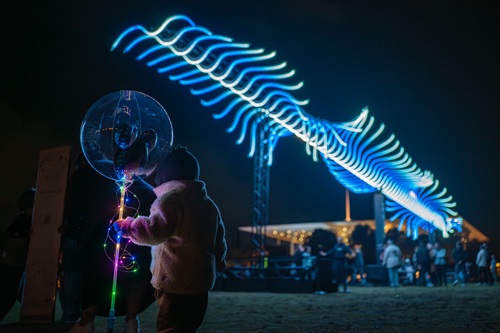 The “BioLumina” Light Installations Festival over the Christmas holidays in the gardens and lawns of the Stavros Niarchos Foundation Cultural Center (SNFCC), included artwork simulating birds in flight, fluttering butterflies and a whale diving in a make-believe ocean.
"The Farm” exhibition at the National Glypthotheque (National Sculpture Gallery) displays animal and bird-themed works of Greek artists from its permanent collection.
The Cow | Deer play ran for a limited time at the National Theater of Greece in collaboration with the Royal Court Theatre of London, UK. Without dialogue, the four performers and musicians onstage evoke the lives of two animals, a cow and a deer, through sound, allowing the spectator to experience the “more-than-human world.”
Other resources:
- Discover Magazine - Why Did Our Paleolithic Ancestors Paint Cave Art
- Designboom.com - 'why look at animals?' at EMST: katerina gregos on speaking for the voiceless
- Why art is important | Katerina Gregos | TEDxGhent
- Tiziana Pers - National Museum of Contemporary Art Athens
- Art Orienté Objet - National Museum of Contemporary Art Athens
- Daniel Steegmann, artist website
- Marcus Coates, artist website
Photo credits: All photos used with permission of EMST and SNFCC.
1. Τiziana Pers, Do Not Forget / The World To Come, 2025, Installation view, Dimensions variable, Neon sign in English and Greek, Produced by EMΣΤ, Courtesy of the artist, Photo: Paris Tavitian
2. Gustafsson & Haapoja, Embrace Your Empathy, 2016/2025 (installation view), Installation, 20 Flags, Dimensions variable, Co-commissioned by EMΣΤ, Courtesy of the artists, Photo: Paris Tavitian
3. Art Orienté Objet, L’Alalie, 2010, Charcoal drawing on white wall, mechanized broom on timer system, Dimensions variable, Courtesy of the artists, Photo: Paris Tavitian
4. Daniel Steegmann Mangrané, La Pensée Ferale, 2020 (detail), Cibachrome prints and serigraphed texts (text by Juliana Fausto), Dimensions variable, Courtesy of the artist and Esther Schipper, Berlin l Paris l Seoul, Photo: Paris Tavitian
5. Marcus Coates, Extinct Animals, 2018 (installation view, detail), Group of 19 casts, plaster, Dimensions variable, Courtesy of the artist and Kate MacGarry, London, Photo: Paris Tavitian
6. Bird Passing By - Great Lawn of SNFCC, Luminariste (France) - Light Art Collection (Netherlands), Photo: Danai Kokkinaki