
by Dana Cognetta Fritchie, AIWC Frankfurt and Education Team Co-Chair
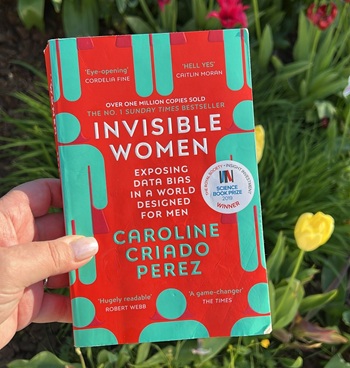 We talk a lot about preparing girls for a digital future. We know that coding camps, STEM programs, and digital literacy initiatives are essential for future success, and the FAWCO Education Team is continuing to explore how we can support these efforts. But what if the future we are preparing them for is already being built around the same blind spots that have held women back for centuries? Caroline Criado Perez’s Invisible Women: Exposing Data Bias in a World Designed for Men asks exactly that question, and the answer should give us all pause.
The book is wide-ranging and meticulously researched—it covers everything from urban planning to healthcare to economics, documenting the ways women have been excluded from the data that shapes our world. This review does not attempt to capture its full scope. Instead, it focuses on what Criado Perez reveals about education and the digital landscape, because it is here that the FAWCO Education Team believes the stakes are some of the most immediate for the girls and young women our clubs serve.
In her book, Caroline Criado Perez argues that there is a gender data gap built into every aspect of our world, and asserts that this gap has significant and often deadly consequences for women and girls. She makes a clear distinction between biological sex and gender, with gender defined as “the social meanings we have imposed on male and female bodies.” The book is organized into six parts, representing a facet of our human experience: daily routines to workplace norms to sexual violence to disaster relief. In each part, Criado Perez lays out with an abundance of research that women are consistently overlooked and ignored. She exposes the implicit biases that shape data collection and the “objective” data that ultimately informs decision-making is meant for a world made only of men. This means that the future we are preparing girls for is not meant for them.
In 2026, the FAWCO Education Team is beginning a series called Beyond the Bias (BtB). This year-long initiative is designed to give women and girls (and the FAWCO clubs that support them), the knowledge, the vocabulary, and the confidence to understand AI, question how it works, and play a role in shaping it. At its core is a central question: How can we move beyond implicit biases in a digital world?
This initiative exists because women and girls deserve a digital future built with them and for them. Criado Perez asserts that to build a world that is meant to work for everyone we need women working on building that world—both our physical and digital worlds. She forces us to contemplate a hard question: what if the AI systems shaping our collective future are already encoded with the same exclusions her book documents, even when women are part of that process? Here are the facts: artificial intelligence (AI) learns from data, and biased data produces biased outcomes. When women are under-represented, misrepresented, or excluded from that data—left out of studies, left out of design sets, and left out of data sets—those gaps become the systems themselves. From the intersection of education and technology, this should send up warning flares.
Criado Perez lays out some very stark facts centering around education. When our children begin school (around age 5), they share a vision that both men and women could be “really, really smart.” Yet the very next year, there is a shift, and brilliance bias sets in: our young female students no longer believe that women can be brilliant. We may think that this is a fixable problem, that we can build into our pedagogical practices that girls and boys share equally the ability to be brilliant. Unfortunately, this is not so simple. Once the brilliance bias has been internalized, it is hard to shake—it actually grows and shows itself when these young girls enter university and the workforce. At the collegiate level, we learn that less effective male professors almost always receive higher student evaluations. An analysis of 14 million reviews on RateMyProfessor.com found that female professors are more likely to be rated unfavorably. Brilliance bias has set in, and female students are perpetuating that bias. In terms of entering the workforce, Criado Perez warns us that “with the rise of algorithm-driven recruiting the problem is set to get worse…the bias is being unwittingly hardwired into the very code to which we are outsourcing our decision-making.”
We know that in our classrooms around the world we are unwittingly teaching our students “almost exclusively about the lives of men.” Criado Perez points to England, where in 2013 there was a debate around the “Back to Basics” initiative in schools. Touted as a way to return to just the facts about history, it was uncovered that women were absent from these facts, save a queen or two thrown in during the Tudor period. In school textbooks in Australia, Germany, Spain and the US over the last thirty years, men outnumber women 3 to 1 in example sentences in language and grammar textbooks. In the US, history textbooks published between 1960 and 1990 pictured men over women by a ratio of 18 to 100, and only 9 percent of the names indexed were of women. In 2017, an analysis of ten political science textbooks featured women at an average of 10.8 percent. The same level of male bias was found in curriculums in Armenia, Pakistan, South Africa and Russia. The invisibility of women in the curriculum sends a powerful message, whether we like it or not: women are not main characters. How do we expect our students to then become adults who believe women are equal?
This matters deeply for how we design educational programs, tools and opportunities for girls. If the curriculum has taught girls that women are not main characters, and if the digital tools now entering our classrooms were built on data that reflects that same exclusion, then adding more girls to existing programs is not enough. We have to ask harder questions: Who is in the data? Who designed the tool? Whose experience was assumed to be the default? Designing for girls means building those questions into every decision—because a system that was not built with women in mind will not serve women well, no matter how many girls we send through it.
Criado Perez does not write this book about education or technology specifically; however, every page has something urgent to say to those of us who work in or are interested in this space. She gives us a framework for asking better questions, and a compelling case for why those questions cannot wait. The FAWCO Education Team’s Beyond the Bias initiative is, in many ways, a response to exactly the challenge she raises: not just preparing girls for the digital world, but equipping them—and us—to shape it. FAWCO Education Team Co-Chair, Lindsay Nygren’s recent article takes that challenge and makes it actionable.
As a final note, I want to stress just how eye-opening this book was. I want to share a few statistics Criado Perez presents, which extend far beyond education:
- Globally, women do three times the amount of unpaid work that men do.
- Snow removal in your city is very likely tailored to men’s travel patterns.
- Worldwide crime surveys/empirical studies show that a majority of women are fearful of potential violence against them in public spaces, and this fear impacts mobility and basic right of access to cities in which they live.
- The US is one of only four countries in the world that does not guarantee at least some paid maternity leave.
- Analysis of performance reviews in the tech space found that women receive negative personality criticism that their male counterparts do not.
- Academia, particularly in the STEM space, is dominated by white, middle/upper-class men. Male academics rated fake research claiming that academia has no gender bias higher than real research which showed it did.
- Female students and academics are significantly less likely to secure funding, secure meetings, be offered mentoring, or be offered a job.
- The US tax system is biased against females (a woman will pay a much higher rate of tax on income than if she filed independently of her higher-earning husband).
- The abuse faced by female politicians makes women more reluctant to stand for office in the first place, which ultimately means that a decline in female representation will give rise to a gender data gap that will then lead to less legislation that addresses the needs of our female citizens.
- There is no international law requiring that women’s voices be included in post-disaster planning.
Source:
Invisible Women: Exposing Data Bias in a World Designed for Men - Caroline Criado Perez, Vintage Books, 2019